
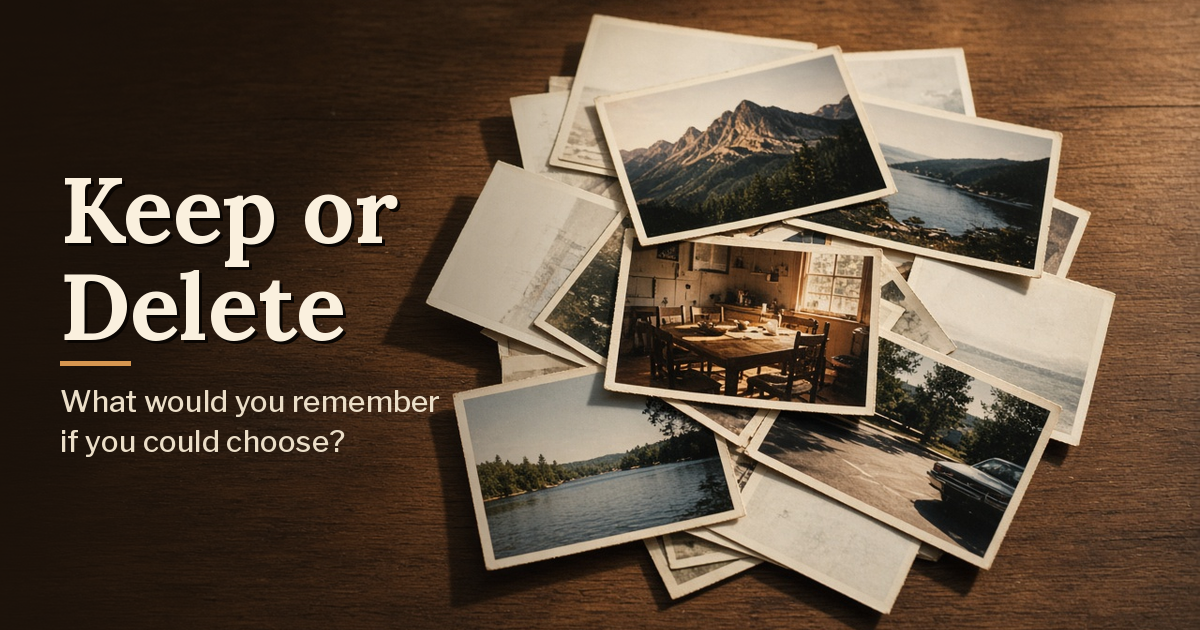
What would you remember if you could choose?
By John W. Crowder
You walk into the kitchen and stand there, trying to remember why you came. You meet someone you’ve known for years, and their name is gone. You can’t recall where you put your reading glasses, even though they’re sitting on top of your head.
Yet something embarrassing you said in the eighth grade comes back in full color, along with the look on everyone’s face. Memory is strange that way. The things we’d love to keep slip through our fingers, and the things we’d love to lose hang on for decades.
What if you could choose? Picture every memory you have coming up for review, one at a time, with two buttons beside it: Keep or Delete.
Most of us would know right where to start.
Out goes the failure you still replay at two in the morning. Out goes the awkward confusion of being a teenager. Out goes the betrayal by someone you trusted, the tragedy you never got over, and the mistake you’d give anything to take back.
In their place, you’d keep the things that faded too soon. The names and faces. The useful things you learned and lost. The laughter around a table, the trip that went just right, the venture that worked. The ordinary good days that slipped away because nothing about them seemed worth holding at the time.
It sounds wonderful. But the longer you think about it, the more complicated it gets.
If you deleted the failure, would you lose the lesson it taught you? If you erased the betrayal, would you see the next one coming? If every memory you kept was a happy one, would you still know they were happy, with nothing to compare them to? And if you edited out every hard chapter, would you still be you?
Some of our worst memories may be doing quiet work we never give them credit for.
* * *
The truth is, there is no delete button. We don’t get to pick what stays and what fades. But we do get to choose something almost as powerful: which memories we rehearse.
Every time we replay a memory, we strengthen it. The hurt we revisit every night grows deeper roots. The good day we never think about again fades a little more. Over the years, the memories we tend are the ones that grow, and the ones we leave alone slowly lose their grip.
That means we have more say than we think. We can hold on to the good on purpose. Write it down. Tell the story at dinner. Pull out the old pictures. If the hard memories stay without any effort at all, the good ones deserve a little effort from us.
And we can let the hard memories finish their work. A painful memory usually has something to teach. Once we’ve learned it, we can keep the wisdom without reliving the wound. We may never forget it, but we can stop letting it run our days.
Long ago, the apostle Paul gave some advice that fits here: “Whatever is true, whatever is honorable, whatever is just, whatever is pure, whatever is lovely, whatever is commendable, if there is any excellence, if there is anything worthy of praise, think about these things” (Philippians 4:8).
You can’t choose everything you remember. But you can choose what you think about. Over a lifetime, that may be the next best thing.
Leave a Reply