
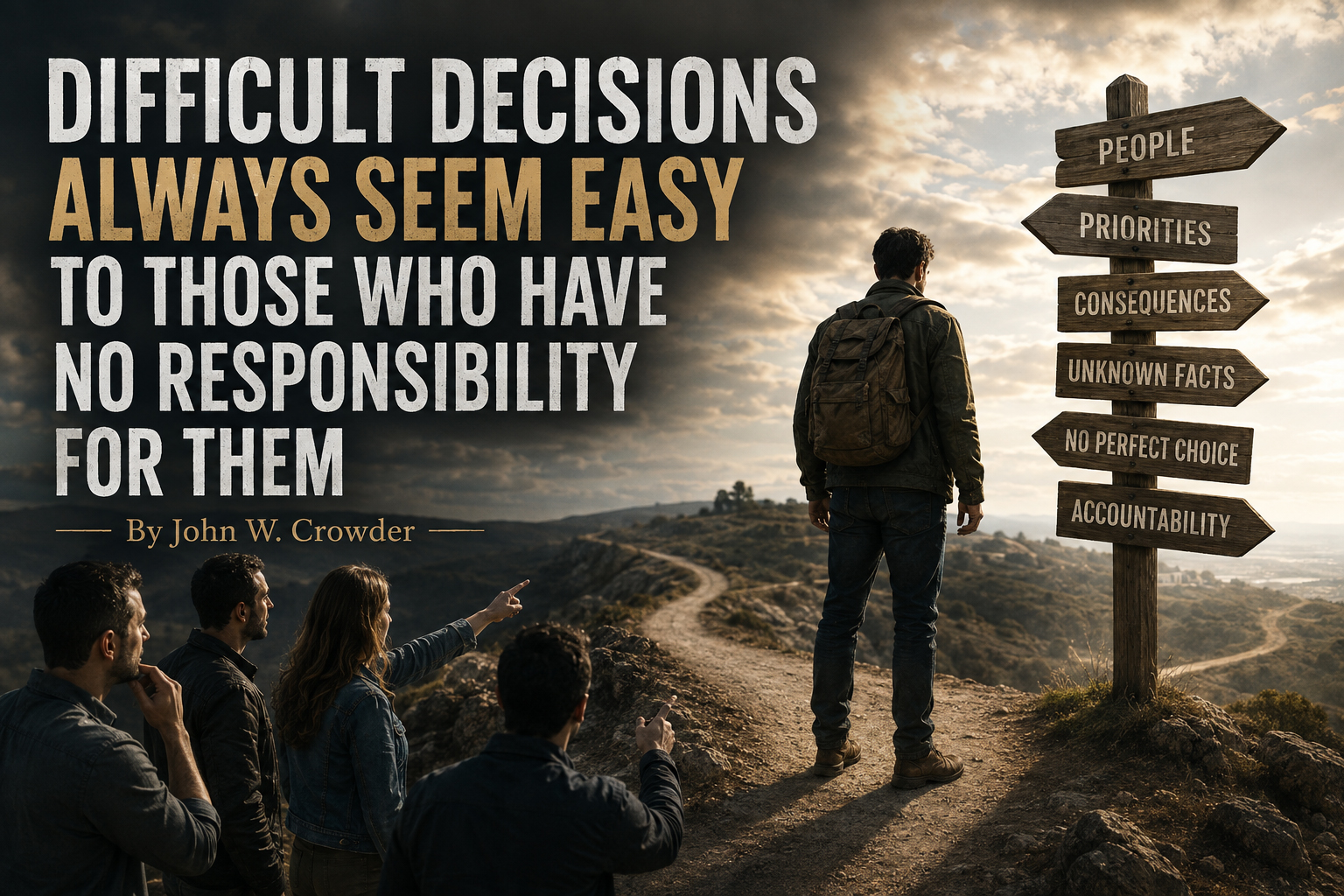
By John W. Crowder
Difficult decisions always seem easy to those who have no responsibility for them. There is a certain kind of confidence that comes from standing outside a decision. You can see it in the coworker who knows exactly what he’d do if he were the boss, the fan who knows exactly which player should have been benched, or the relative who knows exactly how someone else’s marriage should be fixed. Their answers come fast, and they come certain. That certainty is not usually a sign of wisdom. It’s a sign that they will not have to live with what happens next.
It’s not that outside observers are foolish. Often they are intelligent, well-meaning people. It’s that distance manufactures a kind of false clarity. From the outside, you see two options and an obvious answer. From the inside, you see six competing obligations, incomplete information, and people who will be hurt no matter what you choose. The view is different depending on who has to carry the weight of the consequences.
Why Distance Creates False Clarity
Responsibility changes how a person sees a problem. When you are not accountable for an outcome, you are free to focus on a single value; be bold, be cautious, be fair, be fast, and ignore everything that value would cost you. The person actually charged with the decision doesn’t have that freedom. He has to hold several good values in tension at once, knowing that whichever one he prioritizes, he will answer for not focusing on the others.
This is why the loudest critic of a tough decision is almost never the person who is in a position to make a better one. It’s easy to criticize a general’s strategy from home. It’s much harder to criticize it while standing on the battlefield, with limited supplies, incomplete intelligence, and real people whose lives depend on being right.
A Pattern Even in Scripture
This isn’t just a modern observation. It shows up throughout the Bible in the lives of people who carried real responsibility for others.
Think about Moses. Over and over, the Israelites in the wilderness complained about his leadership, sure they knew better. “Would that we had died in the land of Egypt… for it would have been better for us to serve the Egyptians than to die in the wilderness” (Exodus 14:12, ESV). But they carried none of the burden Moses carried. He was the one standing between a frightened, exhausted nation and a God whose holiness he took very seriously. Their complaints were easy to voice because the responsibility was not theirs to carry.
Remeber Nehemiah? When he set out to rebuild Jerusalem’s walls, his fiercest opposition came from men with no stake in the outcome. Sanballat and Tobiah mocked the effort, certain they knew how flimsy and foolish it was: “Even a fox going up on it would break down their stone wall!” (Nehemiah 4:3, ESV). They had no city to protect, no families sleeping exposed within broken walls, and no accountability if the project failed. Nehemiah did. His response wasn’t to silence every critic, but to keep building while trusting the Lord: “Our God will fight for us” (Nehemiah 4:20, ESV).
Consider Solomon’s famous “split the baby” ruling in 1 Kings 3. Two women stood before him, each claiming to have the same child. To everyone watching, it may have looked like an impossible case. To Solomon, it was a decision only he could make, and one he alone would answer for. Scripture tells us “all Israel heard of the judgment that the king had rendered, and they stood in awe of the king, because they perceived that the wisdom of God was in him to do justice” (1 Kings 3:28, ESV). Wisdom of that kind isn’t developed by people who never have to make a decision.
What This Should Teach Us
If you are not the one carrying responsibility for a hard decision, this truth should remind you to be humble. You may still have wisdom to offer. You may see something the decision-maker has missed. There might be an opportunity for you speak, but hold your certainty loosely. The chances are, the issue is more complex than you realize and your sense of clarity is a privilege of your distance from any consequences. Ask questions before you offer easy answers. Extend the kind of patience you would want if the weight were on your shoulders instead.
If you are the one who carries the responsibility, don’t be surprised or wounded when easy answers arrive from people who don’t have to live with the results. That’s simply the nature of the burden you carry. Let it drive you, as it did Moses and Nehemiah, back to dependence on God rather than resentment toward the people around you.
Difficult decisions always seem easy to those who have no responsibility for them. The rest of us would do well to remember that the next time we’re tempted to hand out a quick, confident answer to someone else’s hard choice.
Leave a Reply