
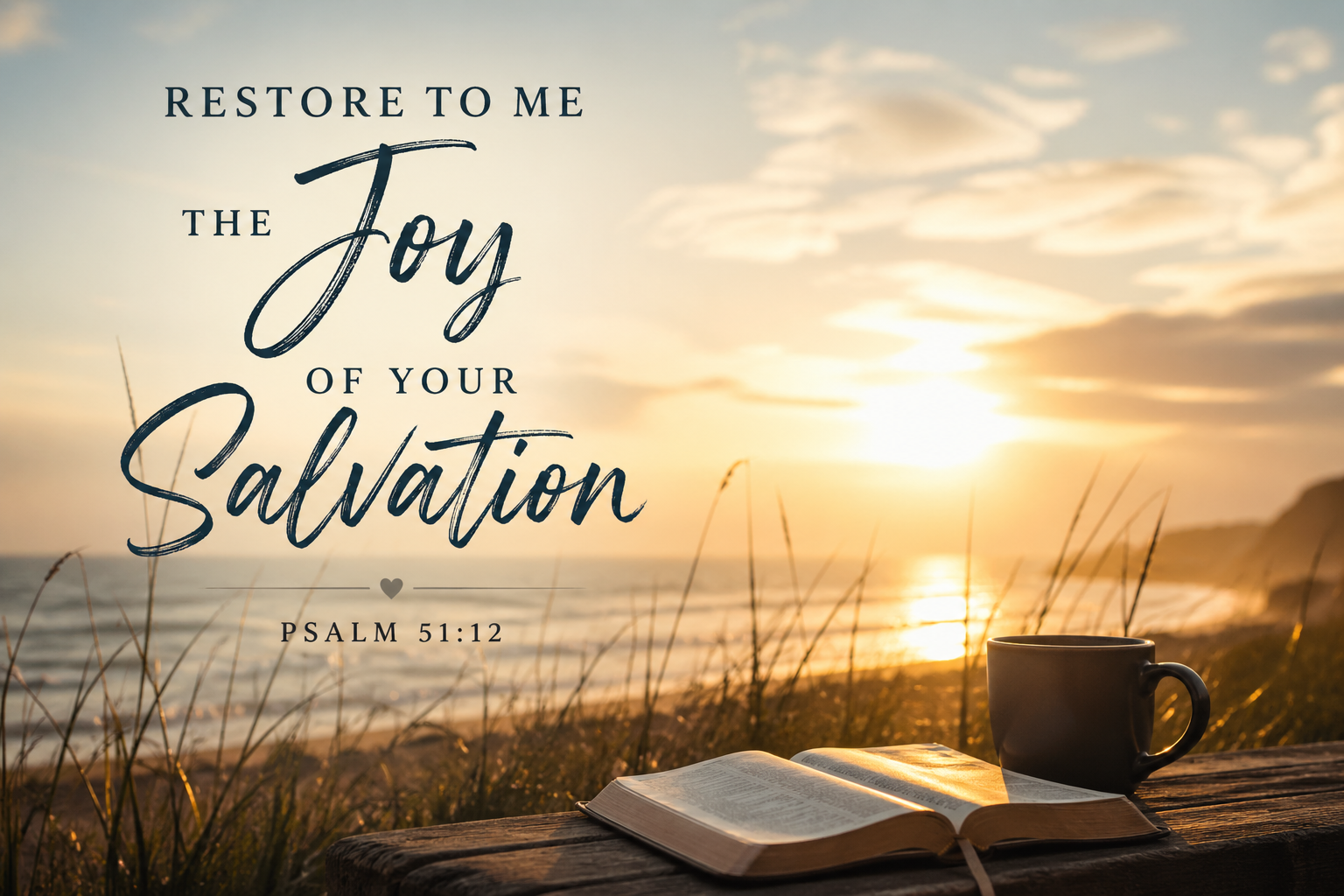
“Restore to me the joy of your salvation, and uphold me with a willing spirit.” — Psalm 51:12 (ESV)
This is a prayer that has been prayed across the centuries by people who knew exactly what it felt like to drift from God and ache to come home. It is not a long prayer. It fits in a single verse, but it carries the full weight of longing heart. The believers who pray this have seen the distance between who they once were and who they have become.
Psalm 51 is David’s prayer of repentance after his sin with Bathsheba. Perhaps you can picture David, broken and humbled, on the floor before God. He is not negotiating, not explaining, not minimizing, he is just asking for mercy. And near the center of that prayer, almost like the turning point of the whole psalm, comes verse 12:
“Restore to me the joy of your salvation, and uphold me with a willing spirit.”
That is one of the most honest prayers in all of Scripture. And I think many of us, if we are willing to be truthful, have prayed it ourselves, even if we never knew the words.
He Has Lost Joy, Not Salvation
The first thing to notice is what David is not asking for. He is not asking to be saved again. He is not suggesting that his relationship with God has been severed or that he must start over from the beginning. He is asking for something specific that he has lost: the joy of salvation.
That distinction matters enormously. There is a difference between losing your salvation and losing the joy of it. David still belongs to God, but sin has done something very real to the way he experiences that relationship. It has robbed him of fellowship, clouded his confidence before God, and drained the spiritual vitality from his inner life. Sins always separates.
You can feel that loss in the surrounding verses. In verse 8, he cries out, “Let me hear joy and gladness.” In verse 11, “Cast me not away from your presence.” These are not the words of a man who is indifferent. They are the words of a man who remembers what closeness with God felt like, and now feels the silence where that closeness used to be.
Sin did not erase his salvation. But it eroded his experience of it. And that erosion was real, and it hurt.
“Restore”
The word David uses is important. He does not ask God to give him something new. He asks God to restore something old. To bring back the joy that was once there.
That means David remembers. He knows what it used to feel like to worship freely, without the weight of unconfessed sin pressing down on him. He knows what it felt like to delight in the Lord, to pray with confidence, to move through his days with a clear conscience. That freedom is not theoretical to him. It is a vivid memory. And the memory makes the absence even more painful. “Restore” carries the idea of returning something to its former condition, like setting a broken bone, or refilling a vessel that has been emptied.
It means David believes restoration is available to him. He has not concluded that he has sinned too badly, drifted too far, or waited too long. He comes to God not with resignation but with expectation, believing that the God who gave the joy in the first place can give it back.
“The Joy of Your Salvation”
Now look carefully at the wording. David does not say, “Restore to me my salvation.” He says, “Restore to me the joy of your salvation.”
That is a theologically precise phrase, and I do not think it is accidental. David is not claiming ownership of something that belongs to him. He is recognizing, in the middle of his prayer, that salvation belongs to God. It is God’s work, God’s gift, God’s initiative.
What David longs for is the deep, settled gladness that comes from being forgiven, being right with God, and walking closely with him. That joy is not manufactured by positive thinking or spiritual effort. It flows from the reality that we are known by God, loved by God, covered by God. When sin breaks that fellowship, the joy goes with it. And when repentance restores the fellowship, the joy comes back.
The Second Half of the Prayer
We sometimes stop at the first line and miss what David adds immediately: “Uphold me with a willing spirit.”
This is the request that shows David has learned something from his failure. He is not just asking to feel better. He is asking for the spiritual strength to stay better. He understands that joy and obedience are not different categories — they are deeply connected. A willing spirit, one that is eager to walk with God, is both the fruit of restored joy and a guard against future failure.
David is essentially saying: “Lord, don’t just give me back the feeling. Give me the foundation that produces and sustains it.” He wants the joy, yes. But he also wants the ongoing posture of heart that keeps him near to God rather than pulling away again.
What This Verse Says to Us
If you have spent any time walking with God, you probably know this territory. There are seasons when worship flows freely and prayer feels easy and natural. And there are other seasons when something has happened that blocked the lines of communication. You made a bad choice made, gave in to temptation, started a bad habit, and the distance set in. You still believe. You still show up. But the joy is quiet, and you are not sure how to get it back.
David’s prayer tells us what to do with that. You don’t have to pretend the joy is there when it isn’t. You don’t have to manufacture enthusiasm or fake your way through. You bring the honest prayer: Restore to me the joy.
That prayer assumes several things that are worth naming.
It assumes that God is not finished with you. It assumes that restoration is available, not because you deserve it, but because the God who gave the joy in the first place is the same God who receives broken prayers.
It assumes that the joy of salvation is worth fighting for. Not the initial event of salvation, but the ongoing experience of it: the fellowship, the freedom, the delight of walking with God. That experience can be lost through neglect or sin. And it can be restored through repentance and returning.
And it assumes something beautiful about God: that he does not hold back joy as punishment. When we come back in honest humility the Father runs to greet us. The ring goes on the finger. The robe goes on the shoulders. And the feast begins. (Luke 15)
A Word for Those Who Are There Right Now
Maybe your joy has been quiet for a while. Maybe you know exactly why, or maybe you just sense the distance without being able to name it. Wherever you are, this verse is for you.
David was not bargaining. He was not making promises he hoped God would reward. He was broken, and out of that brokenness came a prayer of breathtaking simplicity: Restore to me the joy of your salvation.
That prayer echoes through every generation because every generation has people in it who know what it feels like to drift — and long to return. You are not the first. You will not be the last. And the God who heard David has not changed.
The joy of His salvation is still available. It is still His to give. And He gives it to those who return to Him and ask.
Leave a Reply