
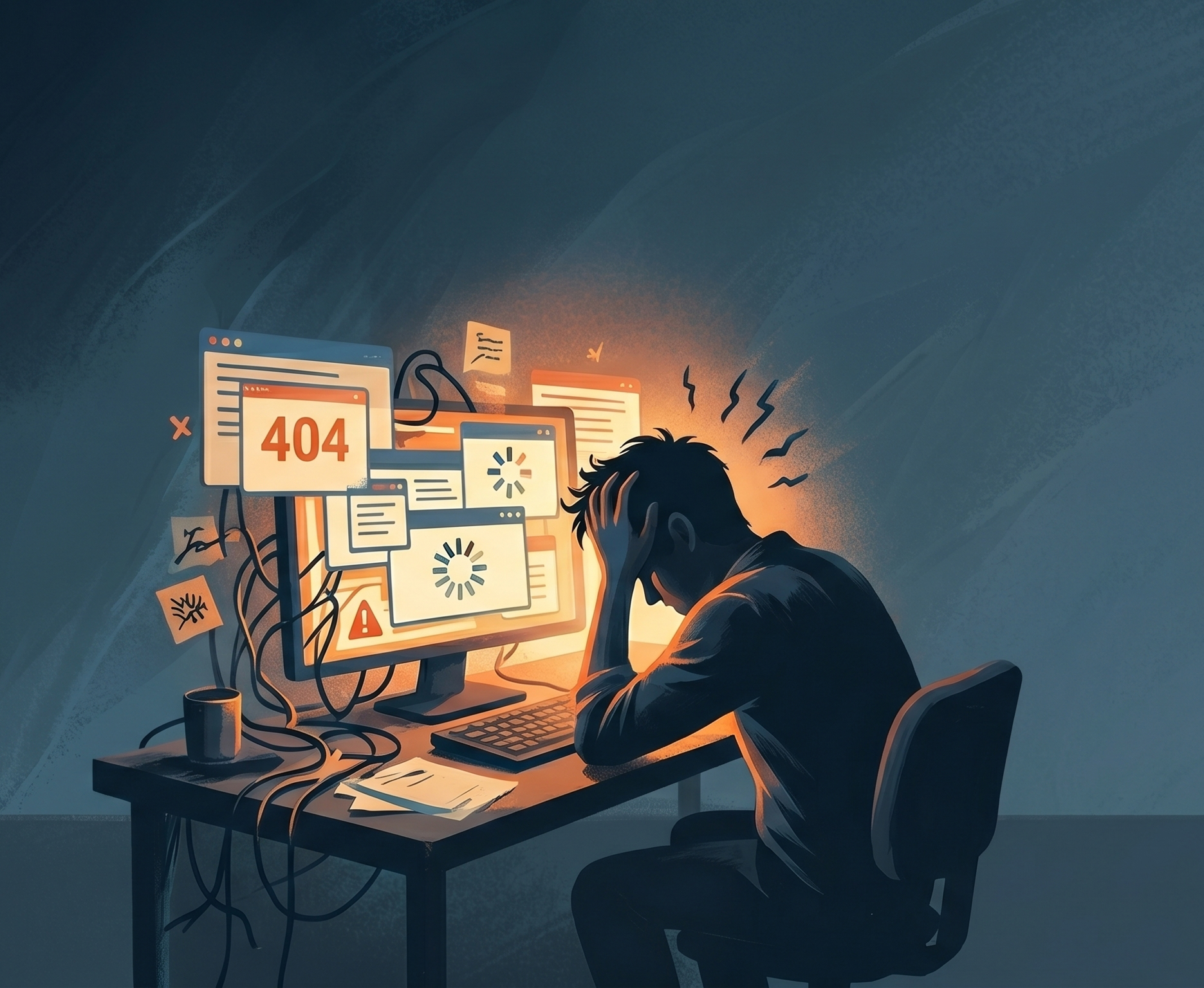
There is a moment every computer user knows. You are staring at the screen, something is wrong, and you have officially entered the troubleshooting spiral. First, you close a few tabs, because surely seventeen open tabs are the problem. They were not the problem. So you Google the error message, which leads you to a Reddit thread from 2014 where someone with a completely different computer, running a completely different operating system, had a vaguely similar issue. You try their solution anyway, with no luck. You restart the one application that seems suspicious. You check your Wi-Fi. You unplug something and plug it back in. You watch a YouTube tutorial that starts with a six-second unskippable ad for a mattress company. Forty-five minutes later, someone walks by and asks the question that should have been asked first, “Have you tried rebooting it?” You have not. You reboot it. It works immediately.
Every one of us has been there. We exhaust every option we can think of before we try the one thing that actually fixes the problem. And the truly painful part? We knew about rebooting the whole time. It just never felt like the right starting point.
We do the exact same thing with prayer.
Something goes wrong, a relationship fractures, a diagnosis sounds bad, a decision hangs over our head and feels too big for us, and we get to work. We think it through from every angle. We call the people we trust. We lie awake running scenarios. We research. We strategize. We manage. We white-knuckle our way through the problem with every tool at our disposal, and when we have finally exhausted ourselves and run out of options, we bow our heads. “Lord, I don’t know what else to do.”
Sound familiar? You are not alone. Not even close. There is something deeply human about this pattern. We are wired to solve problems. Independence gets praised from the time we are old enough to tie our own shoes. Asking for help can feel like admitting we could not handle it. Most of us would rather limp along on our own than admit we need help. Even when the help we are passing up is from God.
But here is what that habit quietly reveals about how we actually view prayer. If prayer is what we turn to when nothing else has worked, then we have unconsciously labeled it “last resort.” It becomes a desperate cry for help rather than a conversation with someone who already knows every detail of the situation and has been waiting for us to bring it to Him.
The Apostle Paul taught us, “Do not be anxious about anything, but in everything by prayer and supplication with thanksgiving let your requests be made known to God” (Philippians 4:6).
He said, “everything”! That means, we pray from the start. Prayer is not our last resort, but it is our first response. Seeing it that way changes everything. Prayer is not a helpline you dial when the situation is beyond you. It is a relationship you bring your whole life into, from the beginning, because that is what relationships are for. You do not wait until you are desperate to talk to the people you love most. You bring them in early. You share things before they become crises. You think out loud with them because their presence and input change how you see everything. That is what God is inviting us into, a real relationship.
So what would it look like to start there? Not to abandon wisdom or stop making phone calls or skip the practical steps, but to begin with prayer the way you might begin a conversation with your closest friend. Before the spiral. Before the sleepless nights. Before the Reddit threads and the YouTube tutorials.
What if the reboot was the first thing we tried? It might save us a lot of time. It might save us a lot of heartache. And it might remind us, in the best possible way, that we were never meant to troubleshoot life alone.
Leave a Reply