But he knows the way that I take; when he has tried me, I shall come out as gold.” — Job 23:10
When life feels unfair, uncertain, or unbearable, it’s easy to wonder where God is. Job knew suffering intimately. He lost his children, his health, and his wealth. His friends accused him. His world crumbled. But in the middle of that pain, Job made a bold declaration of faith: “He knows the way that I take.”
Job reminds us that even in our darkest valleys, God is not absent. He knows—not just facts about our lives, but the heartache, the struggle, the questions we carry. And more than that, God is not wasting our trials. They are a refining fire.
Job believed that when the testing was over, he would “come out as gold.” That’s not optimism. That’s trust in a God who can redeem anything.
Gold is purified by fire. In the same way, trials remove impurities from our character, deepen our faith, and reshape our priorities. The process may be painful, but the outcome is priceless: we are transformed into something more beautiful, more enduring, more like Christ.
📖“We have this hope as an anchor for the soul, firm and secure…”
— Hebrews 6:19a (NIV)

In times of uncertainty, when life’s storms surge and the winds of change howl through our circumstances, we all instinctively search for something — anything — to hold on to. The author of Hebrews offers a compelling image to believers enduring hardship: hope as an anchor for the soul. This isn’t wishful thinking or vague optimism. This is not the fragile hope that says, “I hope things get better,” or “Maybe tomorrow will be easier.” The hope described in Hebrews 6:19 is deeply rooted, immovable, and anchored in the very promises of God.
1. A Hope That Holds
The soul, tossed about by waves of doubt, fear, persecution, or temptation, is anchored by hope. This hope holds us steady because it is based on something unchangeable: God’s promise and His oath (Hebrews 6:17–18). God doesn’t lie. His Word doesn’t falter. His character doesn’t shift with the tides. So the hope we cling to is not only powerful — it’s permanent.
2. Firm and Secure
The verse continues, calling this anchor “firm and secure.” In ancient times, ships depended on strong anchors to keep from drifting. Today, we need something just as solid for our inner lives. The writer uses two adjectives:
- Firm – immovable, reliable, unwavering.
- Secure – safe, locked in place, not slipping or breaking loose.
This hope doesn’t just comfort us — it sustains us. It keeps us grounded when we might otherwise be swept away by grief, fear, or despair.
3. Where Is Your Anchor?
An anchor is only as reliable as what it’s attached to. An anchor thrown into soft sand may not hold; an anchor clinging to solid rock will.
The question for every believer is not, Do I have hope? but rather, What is my hope anchored to? If our hope is in health, wealth, politics, or people — we’ll drift. But if our hope is anchored in Christ, we are held by the very presence of God.
We spend a lot of time, energy, and resources “reinventing the wheel.” I see it most often in disaster recovery. Each community affected by a new disaster has to figure out how to navigate their recovery, starting from scratch. “Reinventing the wheel” is also a common occurrence in ministry, business, leadership, and even raising a family or managing a household.
Image how much further along others could be if we simply shared our wheel with them. Your story is full of experiences and lessons learned. Those experiences carry wisdom now. You can help someone in their journey by sharing portions of your own. Instead of watching someone reinvent the wheel, share the wheel you already carved and help them get further along in their journey with greater ease.
Sharing the Wheel
I carved this wheel with my own hand,
To take me through this new, strange land.
Though others had come this way before
I found no wheel so began the chore.
I toiled in silence, turned each spoke,
With hands that trembled, dreams that broke.
The lessons came, but slow and steep,
With costly wisdom bought not cheap.
But now I see, through clearer eyes,
The cost of keeping truth disguised.
If I have climbed, if I have bled,
Then let another walk instead—
Not where I fell, not where I stalled,
But past the place where I once crawled.
We build to spare, not just to show,
So others faster, farther go.
A gift not in the wheel itself,
But in the hand that offers help.
For every soul must chart their flight,
But need not build alone at night.
What grace to share, what grace to give—
The lessons learned so others live.
So here’s my wheel, not new, but true,
Worn smooth by all that I’ve come through.
Take it, friend. Make it your own.
And may you never roll alone.


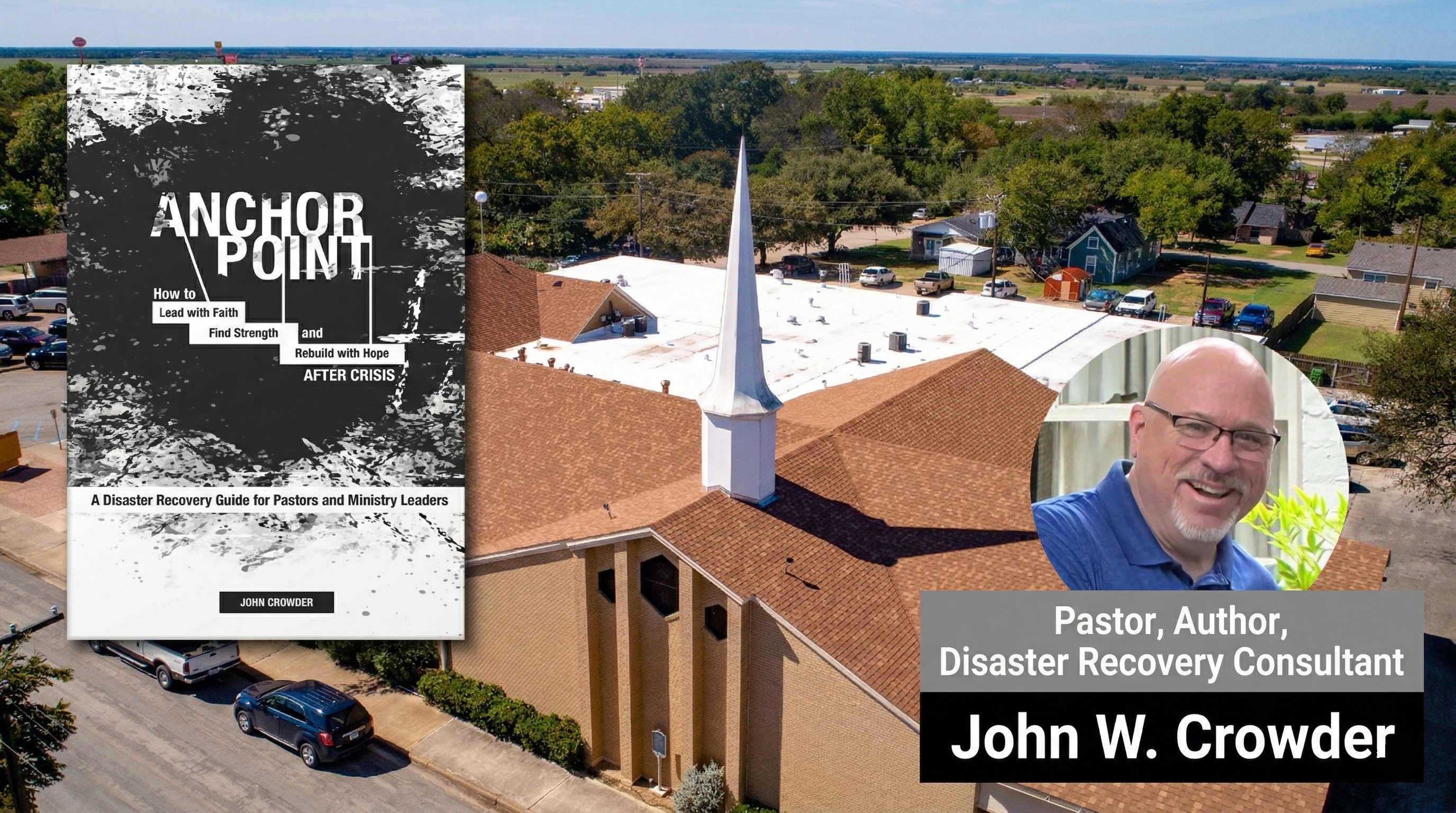
After the explosion in 2013 I discovered that each time there is a disaster, the affected community has to “reinvent the wheel” and learn from scratch how to manage their recovery. I spent the next decade or so studying recovery and working with people who were leading through recovery. I wrote “the book”Anchor Point” in hopes that I could share some of the lessons we’ve learned and give other leaders a head start on their recovery. Hopefully it will help leaders spend more time on helping and healing and a little less time discovering for themselves how disaster recovery works. “Anchor Point” is going to be released on August 12, but it can already be ordered from Invite Ministries.

I often have people ask about which organizations they should send money to after a disaster. The best way to decide is to recognize that there are 2 main phases of recovery: short-term disaster relief, and long-term disaster recovery. The best way to give is to support both of those phases. First, give to immediate relief efforts through organizations who are actively serving the affected community. Then, give to the large funds that are set up by banks or foundations because that money will probably be used for long-term, big needs like medical bills, reconstruction, moving expenses, etc.
I have also put together a check list that I hope is helpful as you decide where and when to send your financial support. Before you send funds to any organization, take these steps:
1. Pause Before You Give
– Don’t feel pressured to contribute immediately.
– Wait until basic information emerges about the scope of damage and credible response efforts.
2. Verify Credibility
– Research the organization’s reputation.
– Check if they have an established history of disaster response.
– Confirm they are a legitimate nonprofit or recognized relief group.
3. Understand How Funds Will Be Used
– Ask for specific information about how donations will be spent.
– Look for transparency about administrative costs, logistics, and direct aid.
4. Prioritize Local Relationships
– Consider giving directly to trusted churches, ministries, or community foundations in the affected area.
– If possible, ask local leaders which organizations are doing the most effective work.
5. Use Established Networks
– When in doubt, partner with reputable disaster relief networks or denominational agencies (Texans on Mission, United Methodist Committee on Relief, Catholic Charities, Southern Baptist Disaster Relief, Samaritan’s Purse, Salvation Army, etc.).
– These groups have trained volunteers and clear accountability structures.
6. Stay Alert for Scams
– Be cautious of new websites, phone solicitations, or social media campaigns that spring up overnight.
– Verify before sharing links or fundraising appeals on social media.
7. Reassess Over Time
– Needs evolve during recovery—what is urgent in week 1 may not be in month 3.
– Consider holding back some resources to meet longer-term needs like rebuilding and counseling.
Guiding Principle
Be as generous as possible, but also as discerning as possible.

Is the church an organization or is it an organism? How we answer that question determines how we view “success” in the church. If it is only an organization, numerical growth is a valid expectation and means of evaluation. If, however, the church is a living organism, growth is not nearly as important as health. There is no denying that the church is structured as an organization. Each local church requires some level of administration to lead and coordinate committees, calendars, records, schedules, etc. While the church functions as an organization, we must not make the mistake of overlooking the fact that it is primarily an organism.
According to scripture, the church is the body of Christ. In I Corinthians 12:11-12 Paul introduces the concept of the church as a body. There is a surprising twist at the end of verse 12, “For just as the body is one and has many members… so it is with Christ.” We might expect Paul to say, “…so it is with the church.” By identifying the many members with Christ, he shows us that the church is literally the body of Christ. The church is the physical presence of Christ in the world today.
Believers who concentrate on church growth are seeing only the surface issues and are dealing with the church as an organization, similar to a country club or fraternal group. Believers who concentrate on church health are seeing the church as an organism and are interested in getting the deeper aspects of being. If we fully understood our role as the body of Christ, we would view our ministry with much more urgency and enthusiasm. The church will accomplish its purpose and its mission only to the degree that it is what it is intended to be. If it is unhealthy, it cannot be all it should be and therefore, cannot do all it should do in the world.

We usually don’t even notice them anymore. I guess that’s to be expected, because they have been hanging there for over a decade now. Those wooden stars have just become a part of the backdrop of our community. There are dozens of them scattered throughout town. Each one is unique, powerful, and beautiful in its own way. Where did they come from and how did they wind up in West, TX?
When a community goes through a disaster, there are many different organizations who show up to help the residents recover. Each organization brings different resources, perspectives, and methods of helping people in crisis. One such organization is Stars Of Hope. What they do brings healing on multiple levels.
First, they set up opportunities for people who are facing tragedy to express themselves through art. As it says on the Stars Of Hope website ( https://starsofhopeusa.org ), there is a “transformative power of therapeutic art.” Plywood stars and paints are provided so people can express themselves and offer messages of hope to their friends and neighbors. Second, those stars are then displayed in the affected community to bring hope and encouragement to the people who are hurting and undergoing the hard work of recovery. Third, painting and displaying the stars is especially helpful to the children. The adults in the community can work at cleaning up, rebuilding, raising funds, making plans, reorganizing, etc. Children want to (and need to) be a part of the recovery efforts as well, but what can they do? As kids, they can’t do all the hard work the grown-ups are involved in, but they can paint! When Stars Of Hope came to West, they brought a project with them that kept the children busy for a while and allowed the adults to have some time to work, but more than that, the kids got to do something meaningful! The children were not just occupied for a little while, they were making a difference! Their stars brightened the dark days of struggle and recovery, bringing the hope and encouragement our community needed to keep going.
Why are the stars still there after all this time? Becasue they are a part of our story. They remind us that as a community, we depend on each other. They remain as testimony of what a community can accomplish when we work together. They also serve as expressions of gratitude to all the organizations who showed up to help us. I don’t know how long those stars will hang there, but I hope they last a long time, continuing to shine out their messages of hope.

10. Last week’s committee meeting
9. Next week’s committee meeting
8. That issue you’ve been thinking about all week so you could bring it up the next time you saw the pastor
7. Paper towels in the men’s room
6. The name of that couple who sat behind you two weeks ago
5. The most recent social media controversy
4. That sermon from 5 weeks ago about that guy in the Old Testament
3. The air conditioning
2. Lunch
And the number 1 thing your pastor is not thinking about 5 minutes before worship begins:
1. Finding you in the crowd to give you a personal greeting
Most likely, your pastor would be glad to visit about any of those things during the week, but right before worship their focus will be elsewhere. Don’t be offended if the pastor seems preoccupied or disinterested in one of those topics at that moment. There are dozens of details that have to be taken care of for a worship service to go well, and the pastor is most likely juggling many of those while focusing on the sermon and the intended purpose of the service that day.

Reading the Old Testament can be challenging sometimes, because it is not always chronological and it contains a variety of genres. That can make it difficult at times to understand the context or the purpose of a particular passage. A few years ago a teenager who was leading a Bible study during lunch at his high school asked me to summarize the story of the Old Testament so he and his peers could get a better understanding what the books are about. Here is the summary I put together for them:
- God created the universe
- Mankind rebelled so God sent the Flood
- Noah’s family began repopulating the world
- God called Abram (aka Abraham ) to begin a new nation
- The Patriarchs were the first fathers of the nation of Israel: Abraham, Issac, Jacob
- Jacob (aka Israel) and his twelve sons moved to Egypt with their families
- While enslaved in Egypt for 400 years, the family became a nation
- Moses led the Israelites out of Egypt and through the wilderness where they received the Law
- The nation of Israel settled in the Promised Land
- For 400 years they were led by judges
- After the judges, they had three kings: Saul, David, Solomon
- The nation divided in 930 BC: ten northern tribes were Israel and two southern tribes were Judah
- Prophets warned the people about their continued rebellion, but the prophets were usually ignored
- Assyria destroyed Israel in 725 BC and the ten tribes were lost forever
- Babylon destroyed the Temple and took much of Judah into captivity in 586 BC
- Some who had been exiled in Babylon returned to Jerusalem (capital of Judah) and rebuilt the wall and the Temple
Here is a simple summary of the timeline: Creation — Flood — Patriarchs — Egypt — Law — Wilderness — Promised Land — Judges — Kings — Exile — Return
I have also prepared a document that lists each book of the Old Testament and gives a short, one paragraph explanation of why it was written and where it falls in the story described above. If you are interested, you can find that document at this link: https://wacorba-sites.s3.amazonaws.com/fbcwest/2024/01/15112910/Overview-of-The-Bible.docx

The holiday has passed. The festivities have ended. Wrapping paper which once hid wonderful mysteries and adorned thoughtful gifts now clutters a cold floor. The stockings that were hung by the chimney with care now lay empty and forgotten on the hearth. The guest room is empty once again. The house is strangely quiet and still. The sink is full of dishes and the refrigerator is full of leftovers. A weary tree is leaning a little and it seems to have grown tired from holding its limbs up for so long. The candles were blown out long ago, and the lights have been unplugged for the last time. Even the poinsettias on the porch are beginning to curl and they look a little more brown than red. That man was correct who once said, “Ain’t nothing as over as Christmas.”
Christmas was yesterday, so the party is over, but the reason for celebration remains. We remember the birth of Christ by celebrating Christmas, but we experience His presence and power at work in our lives every day, whether the calendar reads December 25 or not. The night He was born, the angels declared His arrival by saying “Unto you is born… a Savior who is Christ the Lord.” He was born on that specific day, but He is and will always be our Savior, Christ the Lord. Isaiah prophesied that He would be Emmanuel, which means “God with us.” He entered into humanity on Christmas but He remains here still. He is always our Emmanuel.
The holiday is over. The party has ended. Christmas has passed. The meaning of Christmas, however, lingers with us. The Light has come into our dark world changing it forever. Love reached out to us and brought us hope, peace, and joy. Nothing can change that. The calendar does not dictate an end to our rejoicing. The Son of God has come! Every day can be a celebration of all He has done for us. He came that we might have life and live it abundantly. That doesn’t change when the Christmas carols end or the decorations are packed away. We might not say “Merry Christmas” again until next year, but there is still much joy to be found, no matter what day it is.
Christmas is over, but the meaning and our celebration of it remain – forever.